


Review: Gears of War: E-Day (XBOX)

E for Exciting Combat, but also E for Exasperating Storytelling.

Spoilers Ahead
Gears of War: E-Day should have been a surefire, no-brainer win for developer The Coalition and XBOX. Take the series back to basics with a prequel that is set at the start of the Locust War starring two of the most beloved members of the core cast: Marcus Fenix and Dominic Santiago. Dom, in particular, was a treat to have back, as the character has been dead since Gears of War 2. On paper, one can at least start to understand why Microsoft rationalized spending (allegedly) $500 million on the production of E-Day: this was to be the start of a new trilogy and a return to form and relevancy for one of the series that helped build the XBOX brand.
Then E-Day actually launched, and, well... the numbers were terrible. And worse, fans weren't happy. The question for many, though, is whether E-Day is truly a so-called woke catastrophe or if maybe fans and online pundits are simply being unreasonable about the game. And the answer is, it's complicated. Yes, aggressive social messaging is part of E-Day's problem, but it's also the victim of poor storytelling and rough gameplay that, while mostly serviceable, is in some ways not as polished as the first game that came out 20 years ago. E-Day has some genuinely enjoyable moments, but it's also undercut by mistakes that could have been easily avoided in the first place.
Six weeks after the conclusion of the Pendulum Wars, Marcus and Dom are sitting in a bar in Kalona after ditching a tribute to fallen COG soldiers, including their friend and brother (respectively) Carlos Santiago. As they talk about the Battle of Asphos Fields, where Carlos made the ultimate sacrifice, suddenly the entire bar begins to shake as the Locust Horde emerges for the first time, sending the world into chaos. Marcus and Dom are joined by cadet COGs Lucas Reyes and retired veteran Mags Carter as they head out into the city to see what they can do to help. Eventually, the crew hooks up with COG and becomes Bravo Squad.
As Marcus and company begin to explore Kalona, it quickly becomes evident that this is easily one of the best-looking entries in the series. Kalona is a sprawling urban metropolis not unlike New York or Los Angeles and is plush with details. Players don't get to start exploring its streets until after the Locust begin to emerge from their subterranean lair, so the Kalona they're introduced to is a slurry of rubble and debris and dead bodies. It's horrific in nature, but glorious in its scope and rendering. Hazy sunlight, embers wafting through the air, and thick plumes of smoke add a lot of atmosphere.

The character models for the Gears crew are good, although the first chunk of the game features everyone in civilian clothing and there's just something a little off with Marcus that's hard to pinpoint. He's a touch leaner than one would expect, that's for sure. Once everyone is armored up, however, the cast finally, truly look the part. Which they should, as the characters are more intricately designed than ever before, with careful attention paid to facial expressions during cinematics and even hand-modeled hair. As the crew goes through skirmishes, there's a real time accumulation of grime and gore on their bodies as they take and dish out damage. It's truly beautiful work that The Coalition should be proud of.
Sadly, this attention to detail and sense of authenticity doesn't fully extend to the narrative. Story arcs and characterization for much of the cast are predetermined by identity politics. This is most apparent with Colonel Elias Trench, whose role as the unscrupulous military leader determined to win no matter what atrocious actions he has to commit was set the moment he was made to be an old, white male. The second he's introduced in the story it's clear that he's being set up as an antagonizing presence specifically because of his race and gender.

Conversely, characters like Mags Carter, Captain Akila Grey, Sergeant Major Hank "Russ" Rustin, and Mayor Isabel Shaw are all positioned very carefully in deference to the conventions of progressive social messaging. These characters are all given special attention to either be placed in elevated positions of power (the mayor, Bravo Squad's direct commanding officer, etc.) or in some way included in Gears lore or history such that it makes them fundamentally (and thus indelibly) important. For instance, the character to figure out that a grenade will close up an emergence hole isn't Marcus or Dom, but instead the newcomer Mags. Russ, meanwhile, is a heretofore unknown friend of Adam Fenix and the creator of the immensely important chainsaw attachment on the Lancer.
At a glance none of this sounds like a big deal. After all, what's wrong with knowing who figured out how to plug up emergence holes, or who put a chainsaw onto a lancer for the first time? The answer is nothing—unless the reason isn't story based, but instead politically based. Activist storytellers, as I pointed out in regards to Colonel Trench, cast characters based on identity markers and will frame their entire personalities and story arcs based on these indelible traits. Restrictions are formulated around these traits that limit what a character can or can't do as determined by their skin color, sexual orientation, and so on.

If that sounds insanely bigoted, it is. It's a backwards way of being inclusive that, in reality, is myopic and ignorant, not to mention insulting to the people it's alleging to "represent." Equally troubling is that this mindset means that storytelling is massively hampered because certain characters have to behave certain ways based solely on their identity markers. For instance, because Mayor Shaw is both black and female, she is treated like a queen by all but that naughty white man Colonel Trench. Shaw is portrayed as a saint who lives and breathes for the citizens of Kalona, making her the polar opposite of cold and pragmatic Trench. This is done specifically to illustrate how problematic Trench is—in no small part because of his gender and skin color.
The problem here is that Shaw is good because she is black and Trench is bad because he is white. The races determined what their positions would be within their dichotomy and nothing else. What's more, it's frustrating imagining how much more interesting characters can be if they're not limited by their indelible characteristics. A character like Shaw would be infinitely more engaging if she was allowed to be like a real life mayor of a major city, someone who is more politically driven and morally gray versus an altruistic paragon. But because of identity politics-driven storytelling, what the player ends up with are caricatures of people that wouldn't be out of place in a Saturday morning cartoon.

Equally troubling are some of the storytelling contradictions that popped up in E-Day. Captain Gray is depicted as an overbearing blowhard who wants to do things by the book; when she first meets Bravo Squad, she tells them to give her their names, ranks, and next of kin in a very no-nonsense sort of way. Dom is surprised to have procedure thrown at them in the middle of all the chaos, to which Gray replies that she's there to help bring back order and the chain of command. Her gruff, by-the-book demeanor and scarred face are intended to artificially boost her intimidation factor (and subvert what progressives view as so-called problematic gender norms and beauty standards, another ongoing impediment of Western game design), but there's one, big problem that arises as a result of this exchange, and it takes places just moments later.
After Bravo Squad fights to help lower a bridge in Kalona, Reyes radios in to tell Gray that they completed their objective. Which makes sense, because Gray is a no-nonsense, by-the-book sort of character—naturally, she would want to know Bravo Squad got the job done. Instead, she exasperatedly tells Reyes she can see that the bridge is lowered and the other COGs rib him good-naturedly about his own regimented behavior. What's confusing here is Gray not reciprocating Reyes being by-the-book when that's what she's presented as being the first time she's introduced to the player. She's a stickler because she's returning the chain of command, in her own words, so it then logically follows that Gray would have actually blasted Bravo Squad for not telling her the bridge is lowered. After all, maybe they completed the mission but died at the end as the bridge lowered—that's how a strict leader would behave. But not here.

In fairness, it's not like the Gears games are known for being high art when it comes to their narratives. Indeed, in most cases the Gear series makes an impact because of its gritty, tight gunplay. And in that regard, E-Day mostly hits the mark. Returning weapons like shotguns, Lancers, pistols, and sniper rifles are joined with new armaments like Gut Punchers (a grenade launcher), Rippers (a light machine gun), and Strigas (a sidearm pistol that fires a burst of spikes), to name a few. Everything has excellent feedback, and the variety of weapons gives players a lot of options during combat. There are yellow boxes littered around the game world called Hard Cases that contain new weapons and armor modifications. Meanwhile, Supply Caches are where players can create new loadouts to suit their play styles.
Previous Gears games didn't allow for this level of customization, but I thought it felt like a solid addition in E-Day. I was partial to the sniper rifle early in the campaign, loving the extra firepower it provided against tougher enemies, so it was nice to be able to bring it along at my leisure. One thing that longtime players will doubtlessly appreciate is the ability to implement legacy controls if they're not a fan of the new setup; this is especially important for those with ingrained muscle memory when it comes to running and shooting, and so on. Not that the new control scheme is bad by any stretch. Players more used to being prompted to hit L3 to sprint, for instance, will likely gravitate to the modern setup, instead. Whichever you choose, everyone shot and ran how they were supposed to.
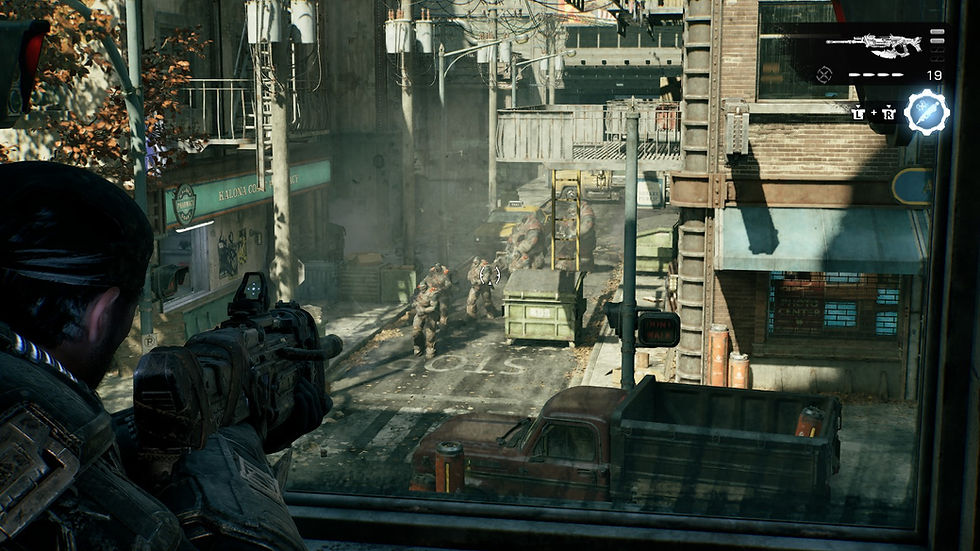
Movement has also been changed up with some additions that have proven controversial among seasoned players. Unlike previous entries, where Roadie Running and mantling were the peak of a COG's agility prowess, E-Day has introduced the ability to jump, slide, and mantle more freely and smoothly than ever before. I mentioned sprinting earlier; that, too, has undergone a facelift, with a gait more in line with modern shooters than the low to the ground, zoomed in style of prior games. On the one hand, these changes provide for a freer flow of movement, but on the other, the more restrained style of the original games felt weightier and had a totally different momentum. It certainly serves to modernize Gears to be more akin to contemporary shooters, but it can also be argued that the chunkier controls are what made the series so unique.
One returning gameplay element that has undergone some changes is the cover mechanic. While previous entries have had destructible pieces of cover, in E-Day it's now far more reactive and dynamic. Whole chunks of environment will break apart into so many pebbles as gunfire tears it asunder. There are also now three levels of cover that your character can take advantage of. As usual, players can go flat against a wall or crouch down for protection, but they can now drop to a knee or go completely prone in order to shield themselves from enemy fire. This opens up new opportunities for cover, thus making combat more varied and challenging.

I did find some of the partner and enemy AI to be lacking while I was playing E-Day. If Marcus got brought down in a firefight, as ever the game allows your squad mates to come revive the player. However, multiple times I would hit the deck right next to Dom or Mags or whoever, and they would stand there oblivious to Marcus, not reacting until a moment or two had passed. The fight with the Bramuk outside of city hall at the beginning of the game was also somewhat buggy, with the towering creature foiled by a large concrete block that I slowly kept circling and using as cover to safely shoot at the monster. Why it didn't simply mount the block and kill me, I couldn't tell you. So while there are many instances that I think E-Day's $500 million development cost shines through, there were others where I was convinced that the prior games did things better and for way cheaper.
I felt that the open world pockets within Kalona and beyond were unnecessary. Open worlds are rarely compelling or worth the effort, in my opinion, especially if it's clear they're being tacked on. In E-Day, there are times the player can branch out within Kalona and Prospect Bay, with 17 different side missions to undertake. Sure, there are some decent rewards for undertaking these quests, but the gameplay itself is pretty rote and unremarkable. Gears is about the giant set pieces and battles; it's okay to let some series stay linear experiences. If the sandbox segments of E-Day were removed, it wouldn't detract from the game one bit. With these segments in the game as they are, they felt more like filler than anything else.

Now, let's get to the elephant in the room: Mags Carter. The focus of a lot of culture wars-based debate, there are many who feel she soaks up too much screen time at the expense of legacy characters like Marcus and Dom. In that regard, I agree; a lot of the campaign focuses on Mags, whether it's through dialogue (she delivers a ton), acting in a leadership position (she's regularly giving orders to Bravo Squad), or just serving up swaths of backstory (her unjust dishonorable discharge, the death of her father, Rustlung, etc.), it's clear that the game wanted Mags to be a thing. There's one unavoidable problem with this, though, which is that Mags isn't who anyone that bought E-Day was tuning in for: it was Marcus and Dom. And they should have been the centerpiece of the plot. Period.
I do think that there's a contingent of players (or at least online haters) who simply dislike Mags for being a lesbian, which I don't agree with. I don't see any problem with having a lesbian character; hearing Dom going on and on about his wife and family is a big part of what makes him who he is, after all. If someone hates Mags just because the game makes it clear she had a girlfriend, then that's their problem. My larger concern is that Mags occupies the amount of space she does because of the aforementioned activist writing tendencies found throughout E-Day; she's there because the politics of the writer (or the C-suite) demand she is, not because she's a genuine boon to Gears lore or the larger E-Day narrative. And when a character exists or is focused on for identitarian reasons, they're rarely authentic, engaging, or interesting.

Mags could have been more interesting, frankly, if she'd been allowed to be a screw up, which is what her dishonorable discharge asserts; the explosion that killed her teammates was because of her negligence. That's the military's summation, but the game explains that in reality Mags was a victim (another progressive fixation) and it was the evil corporation that made a faulty product that was the real reason for the explosion. Because progressivism demands that Mags, as a woman character, and especially as an LGBTQ disabled woman of color, can't be anything less than the best, the writer isn't able to explore the idea of what if it was Mags' fault? What if Mags did screw up and her arc in E-Day was about making up for getting her teammates killed and overcoming the guilt she felt for what happened?
It would have been a heck of a lot more interesting and humanizing to see that flawed version of Mags I just conjured up. But when writers have to adhere to progressive politicking instead of simply telling the best story they can, this is the result: a boring cliche. More importantly, however, is the rug-pull of convincing players that this prequel would be about the characters who built the franchise up and made XBOX a household name. A prequel to Gears should be about Marcus and Dom, about Augustus "The Cole Train" Cole and Damon S. Baird. Not newcomers, regardless of who they are, ESG and DEI be damned. It's the same sort of disrespect that Halo: Campaign Evolved received, where the creators were so slavishly devoted to promoting social messaging that they felt the need to knock Master Chief, let me repeat, MASTER CHIEF, down a peg to promote some no-name side character.

E-Day was apparently meant to be the start of a new trilogy of Gears of War games. With the commercial failure of E-Day being what it is, it doesn't seem likely that a sequel will be dropping any time soon. Thankfully, the game has a definitive end and doesn't leave players with an unresolved cliffhanger. It's evident, however, that XBOX needs to focus on properly going back to what makes Gears popular with its fans. Attempting to shoehorn in new characters is pointless. And unless The Coalition is planning to reboot the series, the studio has written itself into a corner with later games in the series. If they want to give fans Marcus, Dom, and other legacy characters again (the characters fans actually want), then this prequel era and interquels of the original trilogy are pretty much their only options. So stop fiddling around with extraneous odds and ends that are divisive and unnecessary.
As long as XBOX and every other major Western game studio wants to put politicking above the IP, gameplay, storytelling, and so on, there will be more Gears of War: E-Day. A game that delivers mostly satisfying combat hampered by some buggy AI. A game with a narrative that doesn't focus enough on the characters that built the franchise and the company. A game that insults the player and its characters in equal measure by framing storylines around identity markers. A game that works best when it's on a straight path and not mucking around with sandbox gameplay. I think that fans can get a decent amount of fun from E-Day, but it is far from the bold, energizing return that it needed to be.
Thoughts on Multiplayer
Multiplayer remains one of the most important aspects of Gears of War for many fans. E-Day features a mix of returning modes (Team Deathmatch) and new modes (12-player PvE Horde Siege) with four unique classes (Assault, Breacher, Marksman, and Medic) to utilize. The modes themselves are fun, but longtime players will doubtlessly be torn by changes to the gameplay, such as the tweaks I described to things like sprinting and cover. Progression systems like Max Leveling and State Bonuses keep players coming back to become more and more powerful, while cosmetic upgrades are tied to a Medals and Coins-based system that rewards players for engaging with the game. There are some bugs and performance issues here and there, which is especially noticeable on PC. It might not be the best multiplayer in a Gears game, but it's worth a look.

Stunning visuals with detailed character models and environments
Core gunplay remains engaging and challenging
Good weapon variety; loadouts are a welcome addition
Great to see Marcus and Dom together again

Social messaging results in uninteresting new characters whose personalities and arcs are defined by identity markers and not story necessity
Mags occupies too much time when the story should be focused on legacy characters
Some buggy ally and enemy AI
Sandbox sections are uninspired

6
All Bits & Bytes reviews are based on a standard criteria.


